Charlotte, Raleigh, or Greenville?

How Much Money Do You Really Need to Buy a Rental Property in Charlotte?
December 3, 2025
2026 Charlotte Housing Market Predictions for Real Estate Investors
December 3, 2025Charlotte, Raleigh, or Greenville?

Which Southeast Market Offers the Best Returns?
These three markets look appealing for many of the same reasons, including steady population growth, business-friendly environments, relatively affordable housing compared to coastal metros, and strong rental demand.
But while they all check the “fast-growing, landlord-friendly” box, each city behaves very differently once you dig into prices, rents, job markets, and long-term upside. Knowing which one fits your strategy is the difference between a portfolio that merely performs and one that compounds.
Three Markets, Three Personalities
At a high level, Charlotte sits in the middle of the price spectrum with a median listing price of about $435,000 and average rents near $1,945 per month. Raleigh is the most expensive of the three, with median prices closer to $475,000 and average rents around $1,825. Greenville, by contrast, is the most affordable, with prices near $389,000 and rents in the $1,550–$1,560 range.
What’s interesting is that these price-to-rent ratios put all three markets in roughly the same gross yield range, generally in the mid-4% to mid-5% bracket. In other words, the surface-level math isn’t dramatically different. The real differences emerge when you look at scale, job diversity, growth patterns, and regulatory environments.

Charlotte
Charlotte has grown into one of the Carolinas’ strongest economic engines. The region is adding roughly 157 people per day, with more than 23,000 new residents in a single year, placing Charlotte among the top U.S. metros for numeric population growth. That growth is fueled by a diverse economy anchored by finance, fintech, logistics, energy, and a steady pipeline of corporate expansions. SoFi has chosen Charlotte’s Ballantyne for a major hub, and Citi recently announced over 500 new jobs in the city.
This breadth of industries gives Charlotte something both Raleigh and Greenville lack: economic redundancy. No single sector drives the city. When tech slows, banking or logistics often absorb the impact, and vice versa. Investors benefit because a diversified job market generally produces stable rental demand and predictable long-term rent growth.
Charlotte also offers an unusually flexible suburban landscape, Ballantyne, Matthews, Belmont, Huntersville, Fort Mill, Rock Hill, and others, each with its own price point, tenant profile, and rental outlook. This makes Charlotte adaptable to almost any investment strategy: long-term rentals, mid-term corporate rentals, and certain pockets suitable for short-term rentals when zoning allows. For many investors, that mix of yield, scale, and stability makes Charlotte the natural “core market” in a Carolinas-focused portfolio.
Raleigh
If Charlotte is the balanced workhorse, Raleigh is the high-growth sprinter. The Research Triangle, anchored by Raleigh, Durham, and Chapel Hill, has become one of the nation’s premier tech and life sciences hubs, growing tech talent by more than 15% in recent years and earning recognition as the best-performing large metro in the country. Employment in the region rose 12.5% between 2018 and 2023, reflecting its surge in high-earning professionals. Even global biopharma giants like Biogen and Novartis have expanded operations here.
All of that talent pushes demand and prices higher. Raleigh’s median listing price now exceeds Charlotte’s, and while rents are strong, they often don’t rise proportionally with home values. That means Raleigh investors commonly accept lower initial cash flow in exchange for strong appreciation potential and reliable rent increases. The city’s long-term fundamentals are exceptional, but you must enter with realistic expectations: Raleigh is rarely the choice for investors who prioritize immediate returns.
Raleigh does maintain a landlord-friendly environment at the state level, but its short-term rental rules are more structured. Local ordinances require specific permits, occupancy compliance, and limits on STRs in multifamily buildings, nudging many investors toward long- or mid-term rental strategies.
For appreciation-driven investors, though, few Southeast metros are more compelling.
Greenville
Greenville, SC, often surprises investors who think only of Charlotte and Raleigh. Its affordability stands out, home prices near $389,000 make entry far less capital-intensive than the other two markets. Yet Greenville’s job base is robust, thanks largely to Upstate South Carolina’s position as a global manufacturing and logistics hub. BMW’s enormous Spartanburg facility drives billions in economic activity, with Michelin, Boeing suppliers, and advanced manufacturing firms creating a strong employer ecosystem.
Greenville doesn’t have the size or economic diversity of Charlotte or the tech heft of Raleigh. Still, its demand story is consistent: population growth, a revitalized downtown, and jobs that support a broad base of renters. Investors who prefer lower price points, simpler underwriting, and a stable long-term rental market often find Greenville appealing.
However, Greenville comes with two important caveats. First, it is a smaller metro, meaning fewer neighborhoods suitable for scaled portfolios. Second, the city has imposed strict limits on short-term rentals, prohibiting stays of less than 30 days in most residential zones. Investors who want STR exposure must operate in select mixed-use areas or outside city limits.
Which City Fits Which Investor?
When you step back, the choice becomes clearer.
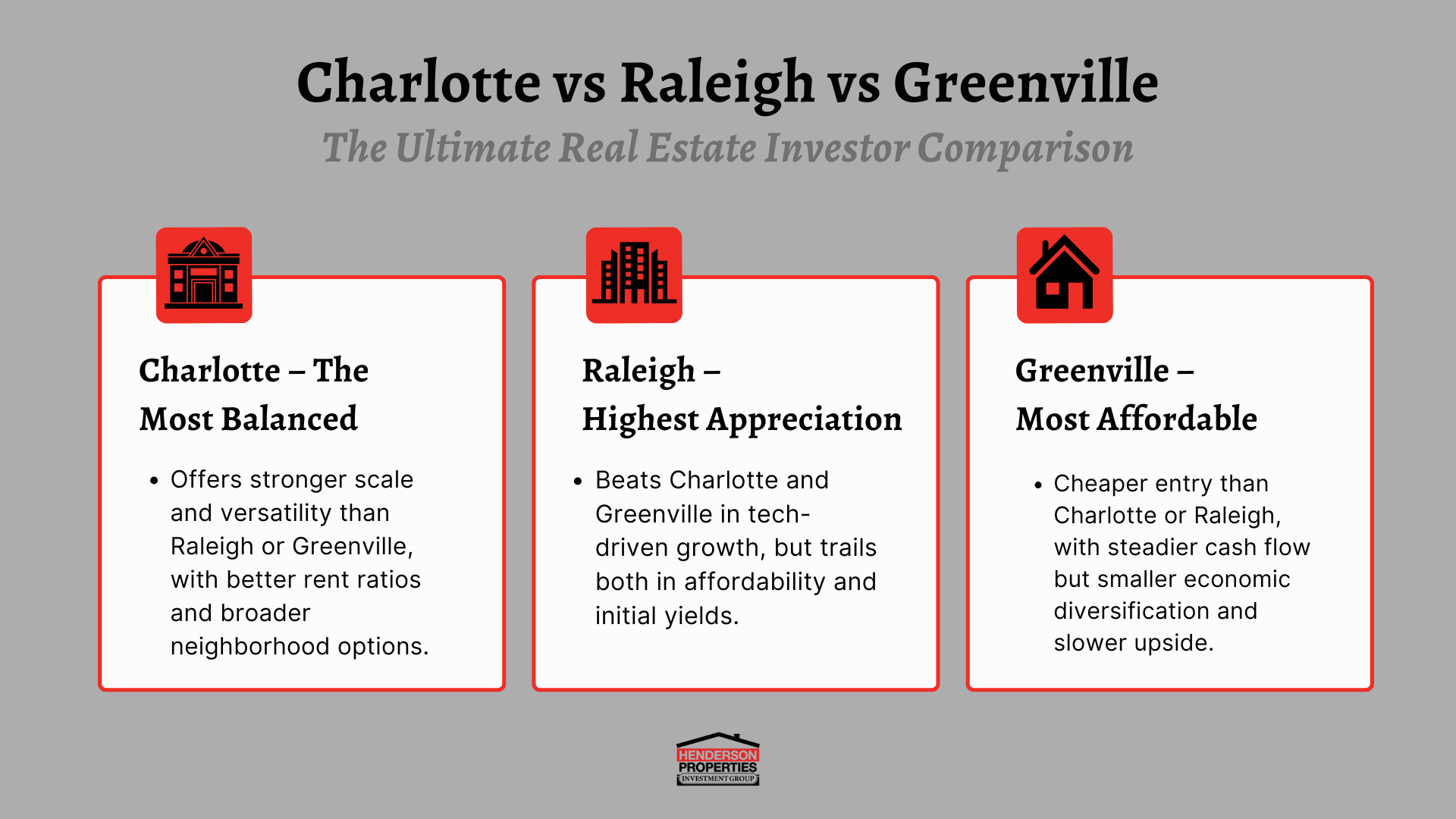
- Charlotte fits investors who want a balanced, scalable, diversified market. You get middle-of-the-road entry prices, strong rent-to-price ratios, huge tenant demand, and a deep suburban landscape that supports every strategy from long-term rentals to corporate mid-term housing. Many investors start in Charlotte because it offers the best blend of practicality and upside.
- Raleigh is the pick for investors who prioritize long-term appreciation and want exposure to tech and life sciences. It’s not usually the cash-flow champion, but few metros in the Southeast offer stronger wage growth, stronger fundamentals, or a more educated tenant base.
- Greenville fits the investor who wants lower barriers to entry, solid long-term renters, and a manufacturing-driven economy. It may not skyrocket like Raleigh or scale like Charlotte, but its affordability and stability make it a smart complement to the Carolinas mix.

Why Many Investors Still Choose Charlotte First
Even if Raleigh’s growth metrics or Greenville’s affordability are tempting, Charlotte often wins because it offers something rare: scale and balance. Investors can find neighborhoods that favor appreciation, others that provide stronger cash flow, and still others that are ideal for mid-term or corporate rentals.
With one of the strongest population-growth stories in the U.S. and continuous corporate expansion, Charlotte creates the kind of predictable demand investors crave.
If you’re ready to see what the Charlotte market can do for you, sign up now to browse available investment properties and start building your strategy with confidence.
Sources & Data Notes
Market statistics in this article were compiled using publicly available data from the following sources:
- Zillow Research and Apartment List Rent Report – Average rental rates across the three metros.
- U.S. Census Bureau Population Estimates – Population growth data for Charlotte, Raleigh, and Greenville.
- WRAL News – Regional reporting on corporate expansions and job announcements.
- Upstate South Carolina Alliance and related economic development reports – Manufacturing ecosystem data for Greenville, including BMW, Michelin, and supplier impact.