How Location Affects Property Value and Rental Demand

Investor-Friendly Real Estate Agents in Charlotte, NC
May 5, 2024
Deciding Between Cash Flow and Appreciation for Your Investment Property
June 27, 2024How Location Affects Property Value and Rental Demand
Your Location Greatly Impacts Home Value
Location affects property value by influencing how many buyers and renters want a property, what they are willing to pay, and how expensive the property may be to own. Schools, employment access, safety, transportation, nearby amenities, zoning, insurance exposure, housing supply, and planned development can all influence resale value and rental demand.
For rental-property investors, a desirable location does not automatically make a property a good investment. The purchase price, realistic rent, operating expenses, property condition, financing, and future competition must still support the overall plan.
Henderson Investment Group helps local and out-of-state investors evaluate rental-property opportunities throughout Greater Charlotte and surrounding North Carolina and South Carolina markets. Learn more about remote real estate investing in Charlotte.
Location Is More Than a Neighborhood Name
Investors often begin a property search by comparing neighborhoods, school districts, commute times, or nearby amenities. Those factors matter, but they are only part of the location analysis. Two properties in the same general area may perform differently because of their street, condition, zoning, insurance exposure, HOA rules, rental competition, or proximity to future development.
Location should be evaluated alongside realistic rent, vacancy risk, ownership costs, property condition, financing, renovation needs, and long-term resale potential.
Review Henderson’s broader guide to Charlotte real estate investment for more information about evaluating local rental-property opportunities.
Which Location Factors Affect Property Value the Most?
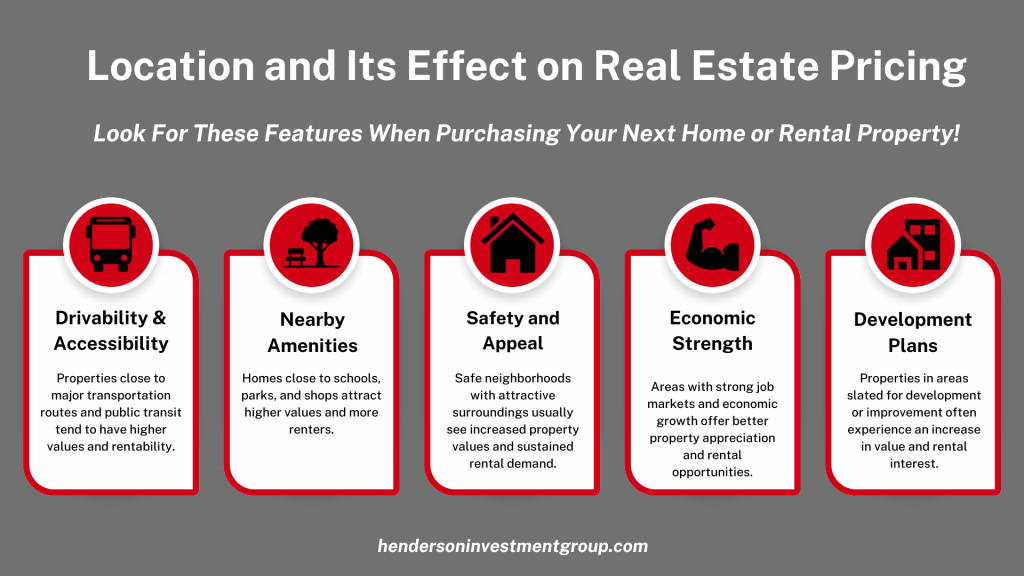
No single factor determines property value. Buyers and renters weigh several considerations at the same time, and the importance of each factor may vary by neighborhood, property type, price range, and likely resident profile.
Employment and Commute Access
Proximity to employment centers, major highways, public transportation, and common commuting routes can affect both buyer and renter demand. Investors should consider where likely residents work and how easily they can reach those areas.
Schools and Education Options
School assignments, nearby private schools, colleges, universities, and other education options may influence demand from families, students, faculty, and employees. Investors should verify current school information rather than relying on an old listing or general neighborhood reputation.
Safety and Neighborhood Perception
Actual safety conditions and public perception can affect how many renters and buyers consider an area. Property upkeep, lighting, nearby vacancies, community appearance, and surrounding land uses may also influence how a location is perceived.
Shopping, Healthcare, Parks, and Entertainment
Access to grocery stores, healthcare, restaurants, parks, recreation, entertainment, and everyday services can make a property more convenient. The amenities that matter most will depend on the likely resident profile.
Zoning and Future Development
Zoning affects how surrounding land may be used and what can be built nearby. Planned housing, commercial development, road projects, transit improvements, industrial uses, or higher-density construction may affect future demand, traffic, noise, and resale potential.
Insurance and Environmental Risk
Flood exposure, drainage, storm risk, nearby waterways, environmental concerns, and previous claims may affect insurance availability and cost. Higher insurance expenses can change the economics of an otherwise appealing property.
Rental Supply and Competition
Investors should compare the property with nearby rental homes, townhomes, apartments, and new construction. A large supply of competing rentals may affect achievable rent, vacancy, concessions, and the amount of time required to place a resident.
Property Taxes and Ownership Costs
Property taxes, HOA assessments, insurance, utilities, municipal fees, maintenance expectations, and other location-specific costs affect the property after closing. Investors should evaluate these expenses alongside projected rent and financing.

What Can Decrease Property Value?
Factors that may reduce property value include persistent safety concerns, substantial deferred maintenance nearby, flood or insurance risks, limited employment access, undesirable neighboring land uses, restrictive rental rules, excessive housing supply, environmental concerns, and major infrastructure problems.
The effect varies by market and property type. Investors should compare local sales, rents, vacancy, development plans, ownership costs, and competing inventory rather than relying on one broad rule.
How Investors Should Evaluate a Location
Investors should evaluate a location based on the property’s likely resident, realistic financial performance, operating requirements, and eventual resale strategy. Useful questions include:
- Who is likely to rent this property?
- What do similar homes currently rent for?
- How many competing rentals are available?
- How quickly do comparable rentals lease?
- Are there HOA or municipal rental restrictions?
- Are taxes and insurance likely to increase?
- What development is planned nearby?
- Does realistic rent support the purchase price?
- Would the property appeal to future owner-occupant buyers?
An investor-friendly real estate agent can help compare rent potential, property condition, local restrictions, renovation risk, ownership costs, and post-purchase management requirements.
Location Analysis Across Greater Charlotte
Greater Charlotte includes urban neighborhoods, established suburbs, expanding commuter markets, lake communities, and nearby South Carolina locations. Each area has a different combination of purchase prices, property taxes, schools, commute patterns, housing supply, resident demand, insurance considerations, and future development.
Popularity alone does not determine whether a property will perform well. Investors should compare the individual property with local sales, realistic rental rates, competing inventory, renovation requirements, ownership costs, and future resale demand.
Henderson helps investors evaluate opportunities within the larger context of Charlotte real estate investment.
Work With a Local Team That Understands Rental-Property Locations
Henderson Investment Group helps local and out-of-state investors identify and evaluate residential rental-property opportunities throughout Greater Charlotte and surrounding North Carolina and South Carolina communities.
Our team can help compare neighborhood demand, realistic rent, property condition, renovation requirements, HOA restrictions, ownership expenses, management needs, and long-term resale considerations.
Investors purchasing from another state can also learn more about Henderson’s support for remote real estate investing.
Discuss a Charlotte Investment Property With Henderson
Our local team can help you evaluate how location, rent potential, property condition, ownership costs, restrictions, management, and resale strategy fit your investment goals.